"there's this like massive exogenous force" haunting mathematics
No, the Leiden Declaration is not a "public cry for help!"

Suppose you invited Sam Altman to read your children a bedtime story. Altman would probably tell them that Goldilocks and the Three Bears is in fact a prescient parable about AI regulation:
“Papa Bear’s bed is too hard.” This means the regulation is too stringent, and China will win the race to AGI;
“Mama Bear’s bed is too soft.” This means the regulation is insufficient, and AGI will bring about human extinction.
While your children are beginning to panic at the realization that the story is not about some imaginary forest creatures and that weird uncle is warning them they’d better kiss their parents goodbye for the last time, you will have slipped out through the fourth wall to ponder why a story with a perfectly understandable moral has been hijacked beyond recognition; and you would be justified in suspecting that something in Altman’s psychology compels him to substitute one of his own obsessions for a story about self-indulgence and entitlement.
Something very similar has happened to the media narrative around the Leiden Declaration.
The timing of the Declaration’s release had been under discussion for more than a month before June 2 was chosen as the day for the official announcement. None of the authors had advance notice that OpenAI would publish its own press release two weeks earlier, entitled
An OpenAI model has disproved a central conjecture in discrete geometry
and accompanied by a companion paper containing remarks by nine distinguished mathematicians, who unaccountably missed the opportunity to engage with the general public’s urgent concerns about AI.
There’s no way to know how the press would have covered the Leiden Declaration under a counterfactual scenario that did not include that Erdős announcement, but I can imagine that turning this serendipitous sequence of two independent events into a coherent cause and effect narrative was irresistible to editors. The Leiden authors have been collecting links to news stories about the Declaration from around the world, in ten languages so far. Nearly every article refers to the OpenAI Erdős announcement, and of those that do, nearly all lead with the Erdős story and only then turn to the Leiden Declaration.
Casual readers are likely to assume that the latter was a direct response to the former. Some of the articles include language that strongly suggest this was the case:
Mathematician and computer scientist Jim Portegies, who convened the Leiden Declaration’s authors and who did more than anyone to keep the writing process on track, set the record straight for a journalist for the Dutch outlet NRC when the latter asked the inevitable question about the Erdős problem:
Het is natuurlijk mooie marketing om te kunnen zeggen: kijk eens, ons model lost een wiskundig probleem op. Maar hun eigenlijke doel is niet het bevorderen van de wiskunde. Voor AI-bedrijven is wiskunde vooral interessant omdat deze wetenschap heel nuttig is om AI strategisch te trainen. Dat komt door het feit dat als AI beter wordt in wiskunde, ook de algemene redeneervaardigheden verbeteren.
Jim’s answer should have put the Erdős cause and effect narrative to rest once and for all, but unfortunately it has only been published in Dutch. Here is a very rough1 translation:
Of course it is clever marketing to be able to say: look here, our model solves a mathematics problem. But their actual goal is not to further mathematics. Mathematics is primarily of interest to AI companies because this science is very useful to train AI strategically. That’s because of the fact that, as AI improves in mathematics, its general reasoning skills also improve.
Not all journalists are on board with the cause and effect narrative. In her New York Times article, Siobhan Roberts interviewed three of the Declaration’s authors and cunningly gave them the opportunity to anticipate the inevitable claims on the part of industry apologists that the framers2, and the (by now more than 2400) signatories of the Declaration, are primarily motivated by fear for our future, asking
Do you worry that the declaration might be seen as mathematicians embarking on a futile effort — circling the wagons in order to save an outdated profession that A.I. is threatening with obsolescence?
Rodrigo Ochigame’s reply should have sufficed, once and for all, to shame into silence any journalist who (unlike Roberts) dared to promote such a narrative:
Ochigame: Mathematics is a rich form of cultural expression with an ancient history, and I am not worried that any technology will ever render it obsolete. Its most precious aspects, such as the collective quest to understand beautifully intricate ideas, and to explore the limits of the human imagination, cannot ever be automated. What I am worried about is that a handful of corporations are mobilizing their vast financial resources to impose an impoverished view of mathematics so forcefully — at a moment when scientific research is already under political attack — that they may well end up destroying the social institutions that allow mathematics to flourish. What could be futile about resisting that?
A very worried document?
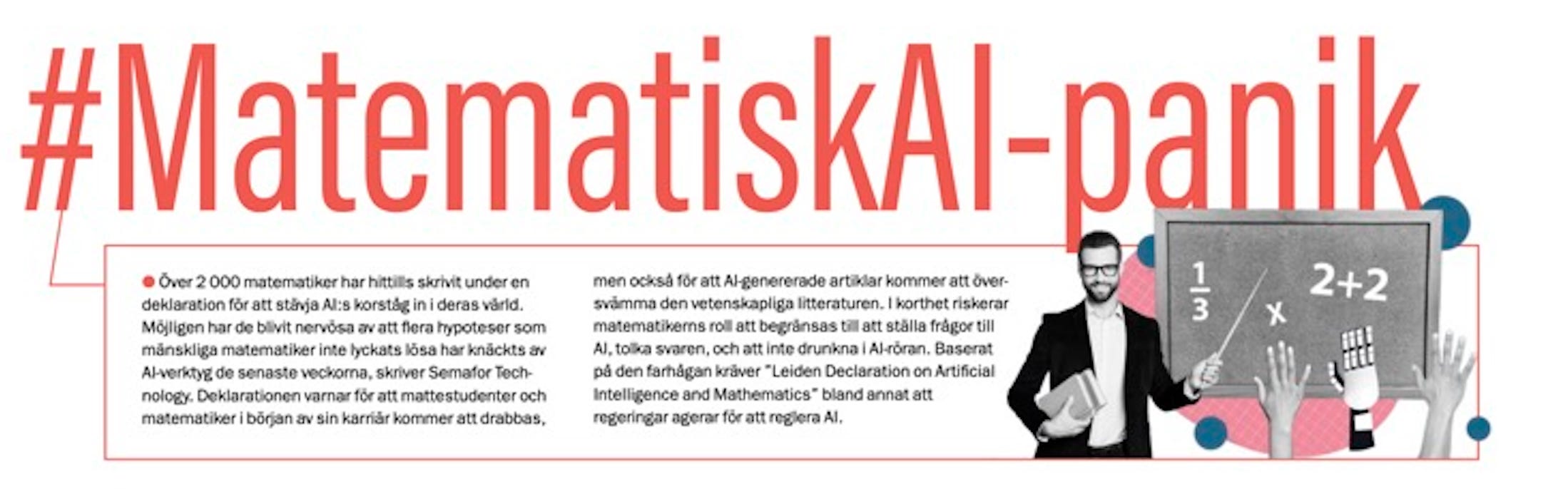
Nevertheless, words like “fear” and “anxiety” reappear consistently in many of the media reports. Science went so far as to call the Declaration a “public cry for help,” and the Dagens ETC article reproduced above, entitled “Mathematical AI Panic,” explicitly linked the Declaration to the Erdős announcement and the like, suggesting3 that mathematicians who signed may be “nervous that several conjectures that human mathematicians have failed to solve have been cracked by AI tools in recent weeks.”
Whether this is a result of misunderstanding, or cluelessness, or bad faith, the misrepresentation of the Declaration’s motivation reached a peak of absurdity on June 5, when Kevin Hartnett was invited to promote his new book on the history of Lean4 on the New York Times podcast “Hard Fork.” A podcast host explained that “actually the reason we wanted to have you on today, was to talk about … this declaration… that I would characterize as a very worried document.” Here’s what Hartnett said:
Mathematicians, I would think, are deeply worried in the way of a population or a community that largely was able to run itself and self-regulate for centuries, and now there’s this massive exogenous force that is shaking it.
Comrades! That “like massive exogenous force” has a name! Moreover, you know what it is! Its massiveness was on glorious display just this week, when SpaceX, after opening on Nasdaq at “a valuation way above an important threshold, a 40-to-one price-to-sales ratio,” actually saw its valuation increase by 19% in a single day. If you think it couldn’t get any more massive, just wait for OpenAI and Anthropic to take their turns. This force will keep shaking mathematics as long as it can build market valuation with whatever gets shaken out.
The real reason
It seems some fear has been generated around the Leiden Declaration, and it’s not where you might expect to find it. But before I get to that I want to clarify what kinds of emotions are motivating the Declaration’s authors and signatories. For this I turn to the science-fiction author Ted Chiang, whose one-sentence Declaration of Principles for generative AI lists at least some of the concerns behind the Leiden Declaration:
Many people feel that LLMs are a fundamentally unethical technology because they are built on the theft of intellectual property, rely on exploited labor, waste natural resources, spread misinformation, deskill workers, stunt the cognitive development of students, and contribute to a consolidation of power that is unhealthy for a democratic society.
(Ted Chiang, “No, Artificial Intelligence Is Not Conscious,” The Atlantic, June 3, 2026)
Let me take that back: this sentence actually appeared in Chiang’s article on AI consciousness, and it is not a Declaration of Principles but rather an empirical observation. It becomes a Declaration of Principles if you remove the words “Many people feel that” at the beginning. Liberated from its imprisonment in a subordinate clause, it is an astonishingly efficient5 Declaration of Principles, and one with each of whose claims I am entirely in agreement, as (I believe) are most of the Leiden authors. More relevant to the present discussion is that nothing in this sentence, which I repeat so you, because you (unlike Anthropic’s Claude) are conscious, can enjoy the full unmediated experience —
LLMs are a fundamentally unethical technology because they are built on the theft of intellectual property, rely on exploited labor, waste natural resources, spread misinformation, deskill workers, stunt the cognitive development of students, and contribute to a consolidation of power that is unhealthy for a democratic society.
— can be honestly construed as an expression of fear. Outrage, or disgust, or indignation, sure. These are the emotions lurking behind Chiang’s placid and methodical enumeration of offenses against the public interest, as they lurk behind the no less methodical paragraphs of the Leiden Declaration, at least for some of the authors. To call either of these texts an expression of fear, a “public cry for help,” as Science did, or a “very worried document,” as in the “Hard Fork” podcast, is not only to insult its authors’ dignity; it is, much more insidiously, a way of neutralizing the Declaration’s impact.
What an actual mathematicians’ panic looks like
Peter Woit’s book Not Even Wrong contains a brief but vivid account of a three-week long episode of mathematical panic, after Edward Witten spoke in 1994 on the equation he had been studying with Nathan Seiberg.
So after that physics seminar on October 6, some Harvard and MIT mathematicians who attended the lecture communicated the remark [about the new equation] by electronic mail to their friends in Oxford, in California, and in other places. Answers soon began to emerge at break-neck speed. Mathematicians in many different centers gained knowledge and lost sleep. They reproved Donaldson’s major theorems and established new results almost every day and every night. As the work progressed, stories circulated about how young mathematicians, fearful of the collapse of their careers, would stay up night after night in order to announce their latest achievement electronically, perhaps an hour, or even a few minutes before some competing mathematician elsewhere. This was a race for priority, where sleep and sanity were sacrificed in order to try to keep on top of the deluge of results pouring in. Basically ten years of Donaldson theory were re-established, revised, and extended during the last three weeks of October 1994.
(Arthur Jaffe, quoted in Not Even Wrong, by Peter Woit, emphasis added)
Was sanity really sacrificed? Did some of the fearful young mathematicians wind up temporarily or permanently deranged after their encounter with the Seiberg-Witten equations?
Woit doesn’t say. This sort of thing happens regularly in mathematics, and is responsible for much lost sleep, but rarely for lost sanity. Andreas Floer can be credited with one such episode, as Helmut Hofer and Siobhan Roberts report in their new book The Floer Jungle. The Grothendieck episode, which lasted more than a decade, much of it sleep-deprived, as Rivka Galchen reported in the New Yorker a few years ago:
What Grothendieck would do is work until late in the night writing up his thoughts, and then throw them downstairs to Dieudonné at 5 a.m., who would then clarify and fill out what Grothendieck had put together until 8 a.m. or so.6
All the principal participants in this episode emerged with great fortitude and with sanity intact, with the exception of Grothendieck himself. The Langlands program, which has defined most of my career, has had a similar trajectory.
Over the last 10-15 years my mathematical universe has been repeatedly reshaped by the work of Peter Scholze and a rotating cast of collaborators, and of the collaborators’ collaborators. If I had to try to keep up with these developments alone I would be tempted to panic; but fortunately I’m not alone.
The great fear
A sector much more influential than research mathematics actually is getting nervous about AI:
the AI machine is exerting a strong gravitational pull on investors’ funds. From talking to fund managers, I know I’m not alone in finding this unnerving. But those same investors also tell me they are ultimately paid to go with the flow.… it could generate a zombie-like self-reinforcing march of investment all towards the same target. That seems to be what is happening already as we fall under the spell of our new robot overlords.
(Katie Martin, Financial Times, June 13, 2026)
The financial press is almost unanimously predicting the bursting of the AI bubble in the near future, but is divided on its long term implications, with some claiming that the development of AI models will contribute to long term prosperity in the same way that the dot com boom crashed but left valuable networks of fiber optic infrastructure, others much more skeptical.7
In the immediate aftermath of its publication, several authors cited the Leiden Declaration’s concern that AI models may not be as reliable as the industry is claiming, referring specifically to the sentence “Don’t believe the hype.” See for example phys.org, Straits Times, and Cybernews, which writes
the declaration – which reads like a very public rebuke – is really far from an endorsement of what’s going on in the AI hype market.
If it’s true that the tech industry has been relying on the word of mathematicians, in their outreach to investors, to vouch for the competence and reliability of their models, the Declaration’s most consequential result may turn out to be the replacement of the the mathematical community’s support by one more reason to be nervous.
As a matter of principle, I decided to look up at most two words, so the translation is probably not quite correct.
Shouldn’t we be using this term in this, the 250th anniversary of the Declaration of Independence?
…referring to an article I have been unable to locate in Semafor Technology…
The Proof in the Code, not yet reviewed but doing quite well on Amazon. I’ve only seen the chapter published in Quanta, which is highly readable; I don’t know whether Hartnett has occasion to identify that “massive exogenous force.”
Peter Scholze’s statement reproduced in my April 29 post is even more efficient, making the same points in even fewer words, but it requires an effort on the reader’s part in order to be understood.
Galchen says she learned this from Colin McLarty.
See Robert Armstrong’s article in the Financial Times, subtitled “Big Tech no longer prints money; it needs it. What will that mean when confidence dips?” Armstrong points out that “After the US housing bubble popped, residential construction never fully recovered, even in a country in dire need of new homes.”
I share your concern about the motives and modus operandi of OpenAI and its peer competitors. But suppose that after "solving math" (motivated to some extent if not primarily by their pre-IPO PR campaign) they make the "tool" they built in the process publicly available (say akin to DeepMind making AlphaFold publicly available to the scientific community). In this scenario too "it's hard to see how the all the social structures that support the subject will be able to avoid major disruption over the next few years" (to quote Timothy Gowers reacting to the OpenAI internal model disproof of the unit distance conjecture).
The great Soviet child psychologist Lev Vygotsky identified the 'zone of proximal development' in which learning takes place through tasks just beyond current skills but typically attainable. Seems relevant to many math and other science/humanities thesis topics from the point of view of the advisor-‘parent’. Looks like recent AI is taking away much PhD ZPD in math and elsewhere, or at least the math/humanities as practiced to date. That's one way to destroy a cultural tradition.