At 10 AM, June 2, 2026, Leiden University published a slightly adapted version of the press release copied below. At 12 noon Leiden time, all other outlets have been authorized to release the text.
The Leiden Declaration was developed by a group of participants in the workshop announced on this site in September 2025. I first announced the ongoing project to draft the Declaration last October 28. The process took a bit longer than anticipated, while different options for the scope of the planned Declaration were considered. These alternatives were discussed at length, by a group of authors whose relations to AI were extremely varied. The following Press Release describes the result. The Declaration itself can be read at its dedicated website.
AI is challenging the core values of mathematics: researchers call for urgent action
The rise of AI forces mathematicians to rethink what makes their field reliable and valuable. In the new ‘Leiden Declaration on Artificial Intelligence and Mathematics’, an international group of researchers warns that AI is putting fundamental values of the discipline under threat.
What happens if a mathematical proof is no longer the work of a human, but of a proprietary AI model that academic researchers cannot access? Who is responsible for errors, and who gets credit if it is correct? And how can we tell whether an AI-generated proof is truly new, or simply a clever reformulation of existing work without proper attribution?
These are no longer hypothetical questions, but current dilemmas mathematicians worldwide are grappling with. That is why an international group of researchers from fifteen universities present the Leiden Declaration: a call to protect the core values of mathematics in the age of AI.
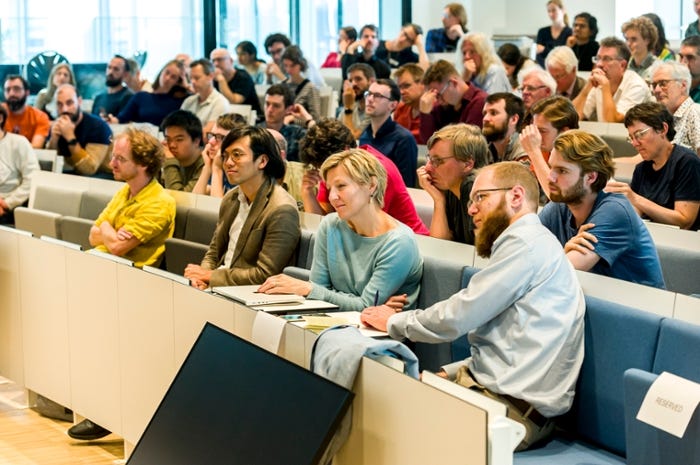
The workshop at the Lorentz Center (see the box at the bottom of the page) where the Leiden Declaration emerged. At the center of the front row, from left to right, are Lenny Taelman, Rodrigo Ochigame, Mateja Jamnik, and Johan Commelin, four of the organisers of the workshop.
The declaration is endorsed by the International Mathematical Union (IMU). Ilka Agricola, chair of the IMU Committee on Publishing, explains: ‘AI is fundamentally transforming the way we do mathematics, and it is doing so at incredible speed. It offers fantastic possibilities when used honestly and competently as a “research assistant”. But this seems to be only a small part of what is going on: the by far larger part is a total mess where science itself is under attack.’
Among mathematicians, these developments have provoked a wide range of reactions. Peter Scholze, director of the Max Planck Institute for Mathematics and a 2018 recipient of the Fields Medal, the discipline’s highest honour, says: ‘This is a wonderful declaration, coming at the right time. The goal of mathematical research is human understanding of mathematics, and so mathematics can only thrive in a community of human mathematicians. It is crucial to preserve this communal spirit. In my experience, mathematical ideas, like children, must be nurtured and grow over the years. Just like I do not want my children to be educated by AI, I am pondering my mathematical ideas without use of AI, and generally avoid reading AI-generated text as best as I can.’
A call for action
The declaration does not ask for AI to be banned, but instead calls for action to ensure the continued flourishing of mathematics. AI is being used to write papers, generate proofs, and assist in peer review. According to the authors, the challenge is to ensure that the technology benefits rather than unrecoverably harms the discipline.
‘Recent AI-assisted results, such as the disproof of the unit distance conjecture by an internal OpenAI model, raise deep worries about closed access, inadequate attribution of related ideas, lack of transparency regarding methods and resource consumption, and much more’, says Rodrigo Ochigame of Leiden University, who co-organised the Lorentz Center workshop where the idea for a declaration emerged.
Five threats to mathematics
The declaration identifies five threats to the mathematical discipline.
1. A publication system overburdened with unreliable results
Mathematics is built on rigorous proofs that provide clear understanding. However, AI can produce ‘proofs’ that look convincing but contain almost invisible errors.
2. Lack of proper attribution and violation of copyright
AI models produce results without citing the human work they build on. This raises questions about recognition and intellectual property.
3. Dependence on AI for results to be considered significant
There is a risk that mathematicians will soon depend on access to the latest proprietary AI technology and expensive computational resources in order to produce competitive results. This leads to inequality between researchers.
4. Overhyping of results
Mathematics values work based on depth, difficulty, and significance. Press releases and blogs often make AI claims without scientific scrutiny. This leads to overestimation of AI capabilities and underestimation of human contributions.
5. Loss of autonomy
When technical feasibility or commercial interests shape research, mathematics risks losing autonomy in setting its research agenda.
On top of these, through AI many areas of mathematics suddenly get drawn into grave ethical concerns with regard to warfare, mass surveillance, political disruption, and environmental damage.
What can individual mathematicians do?
‘AI has the potential to become a powerful partner in mathematical discovery. That power brings new responsibilities’, says Steven Strogatz, distinguished professor at Cornell University. ‘The Leiden Declaration calls on mathematicians to protect what makes our subject trustworthy and illuminating: proof, attribution, and the quest for insight.’
The declaration urges mathematicians to carefully disclose their use of AI and more generally live up to the spirit of open science. It advocates for affirming the humanity of authorship by taking responsibility of their work and putting effort into proper attribution. It encourages mathematicians to take their role in the public debate and to stay informed about the emerging technologies. They should carefully consider which tools to use, evaluate the ethical consequences of their activities and if necessary withdraw from harmful work.
‘The Leiden Declaration offers a helpful framework for mathematicians to decide how, when, and whether to engage with the new technologies.’
– Jeremy Avigad, professor at Carnegie Mellon University and central contributor to the Lean programming language and proof assistant
What should organisations do?
The declaration urges research organisations and journals to take the lead in planning strategically and developing policy regarding the role of AI in mathematics. Leslie Ann Goldberg, head of computer science at the University of Oxford, underscores the urgency: ‘Inaccurate AI-generated drafts are cheap to produce, and there is a risk of cluttering the literature with claimed results that are simply wrong. Once that happens, the errors are likely to propagate as new results are built on faulty foundations.’
For maintaining standards of rigour, protecting the rights of authors, and guaranteeing proper forms of research output, collective action is necessary. Organisations should counterbalance the asymmetric bargaining position of individual researchers entering collaborations with industry by providing access to legal representation and by facilitating the development of codes of professional practice. Finally, funding agencies should take the values of the declaration into account in their evaluation procedures.
Professional societies can play a vital role. According to Agricola, ‘The IMU Committee on Publishing is deeply worried by the current situation, and hence we strongly welcome and support the community effort that led to the Leiden Declaration. Mathematics as we know and love it is at stake!’
What is needed from governments?
According to the declaration, governments should regulate the AI industry and invest in public alternatives to commercial technologies, so that power is not concentrated in private hands.
Requests to commercial AI
The declaration requests collaborations with industry to abide by the same standards expected of academic research. Kevin Buzzard, a professor at Imperial College London who has become a leading figure in the computer formalisation of mathematics, writes: ‘Mathematicians should find it quite striking that tech companies are suddenly interested in their work. The Leiden Declaration is a well-thought-through response to what is currently happening, as AI continues to disrupt this space.’
Beyond mathematics
Although the declaration focuses on mathematics, the authors stress that similar issues arise in other academic fields and creative industries. The discussion therefore raises a broader question: how do we maintain control, reliability, and recognition in a rapidly changing technological landscape?
The message of the Leiden Declaration is clear: AI offers major opportunities, but without clear choices and shared responsibility, it places the foundations of science under severe pressure. According to the authors, we need to act now.
From workshop to declaration
The idea for a declaration emerged during the NIAS-Lorentz Workshop on Mechanization and Mathematical Research in September 2025, which discussed the implications of rapid developments in technology for the practice of mathematics. The event brought together around sixty researchers from ten countries – including mathematicians, computer scientists, and scholars from the humanities and social sciences – and also included a public symposium.
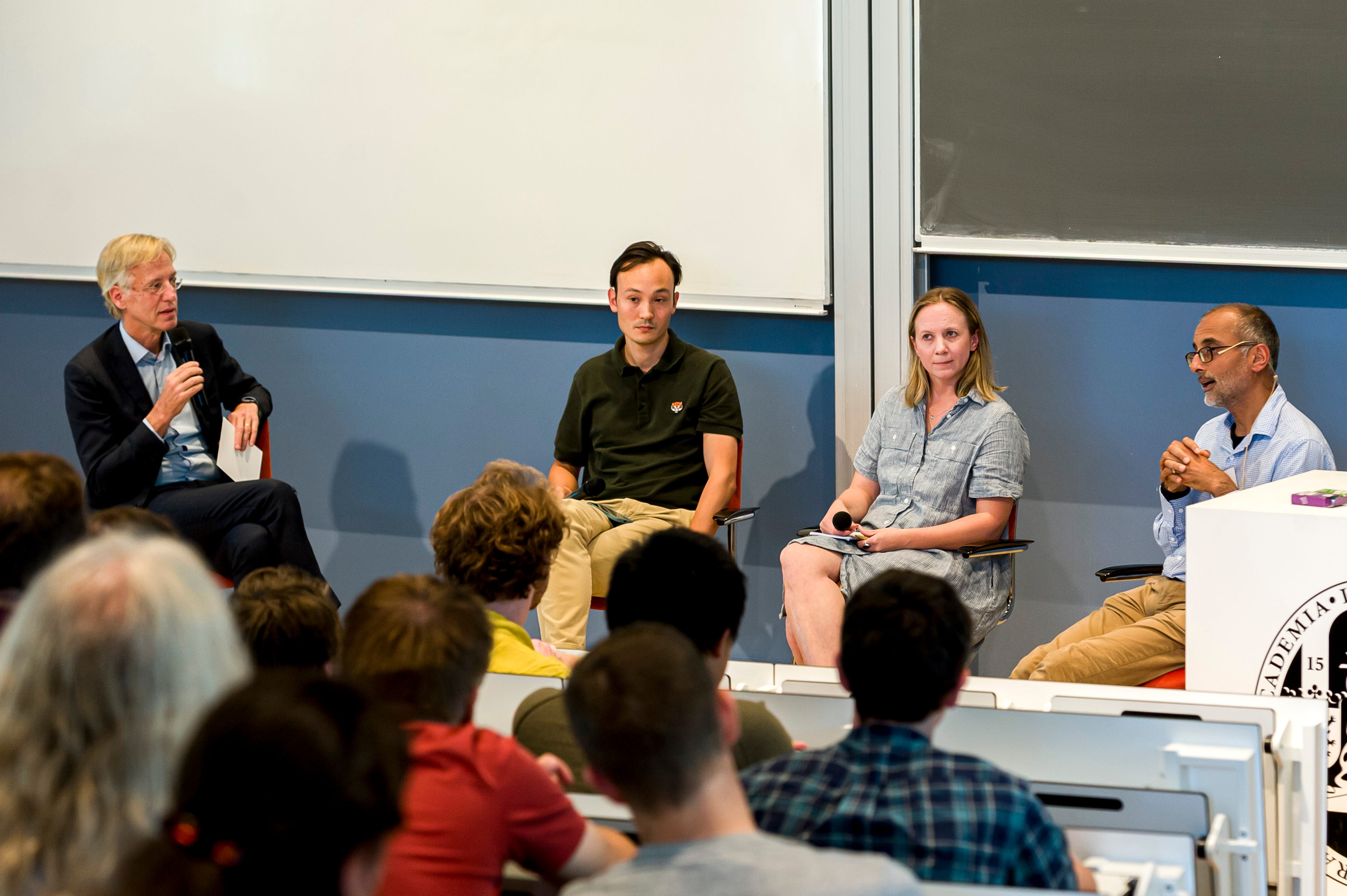
The closing session of the public symposium, moderated by Robbert Dijkgraaf (at left), with Thomas Hubert, Stephanie Dick, and (workshop organizer) Akshay Venkatesh (left to right)
The Leiden Declaration was written by a working group of sixteen participants from this larger group, convened by Jim Portegies of the Eindhoven University of Technology and in consultation with a wide range of members of the mathematical community.
The authors are Jarod Alper (University of Washington), Michael Barany (University of Edinburgh), Alain Chavarri Villarello (Vrije Universiteit Amsterdam), Sander Dahmen (Vrije Universiteit Amsterdam), Walter Dean (University of Warwick), Karthik Ganapathy (University of California, San Diego), Michael Harris (Columbia University), David Holmes (Leiden University), Mateja Jamnik (University of Cambridge), Steven Kelk (Maastricht University), Bryna Kra (Northwestern University), Ursula Martin (University of Oxford), Bartosz Naskręcki (Adam Mickiewicz University and Warsaw University of Technology), Rodrigo Ochigame (Leiden University), Jim Portegies (Eindhoven University of Technology), and Johannes Schmitt (ETH Zurich).
This might be a dumb thing to say, but doesn’t AI create interesting work for mathematicians? Disproving plausible but flawed arguments, proving that a paper relies on unattributed material - isn’t that the fun stuff?


Seems to me this entire argument could be resolved with three words: “Show your work”.
This might be a dumb thing to say, but doesn’t AI create interesting work for mathematicians? Disproving plausible but flawed arguments, proving that a paper relies on unattributed material - isn’t that the fun stuff?