News, rumors, gossip
AI on everyone's mind

“How can I join the resistance?”
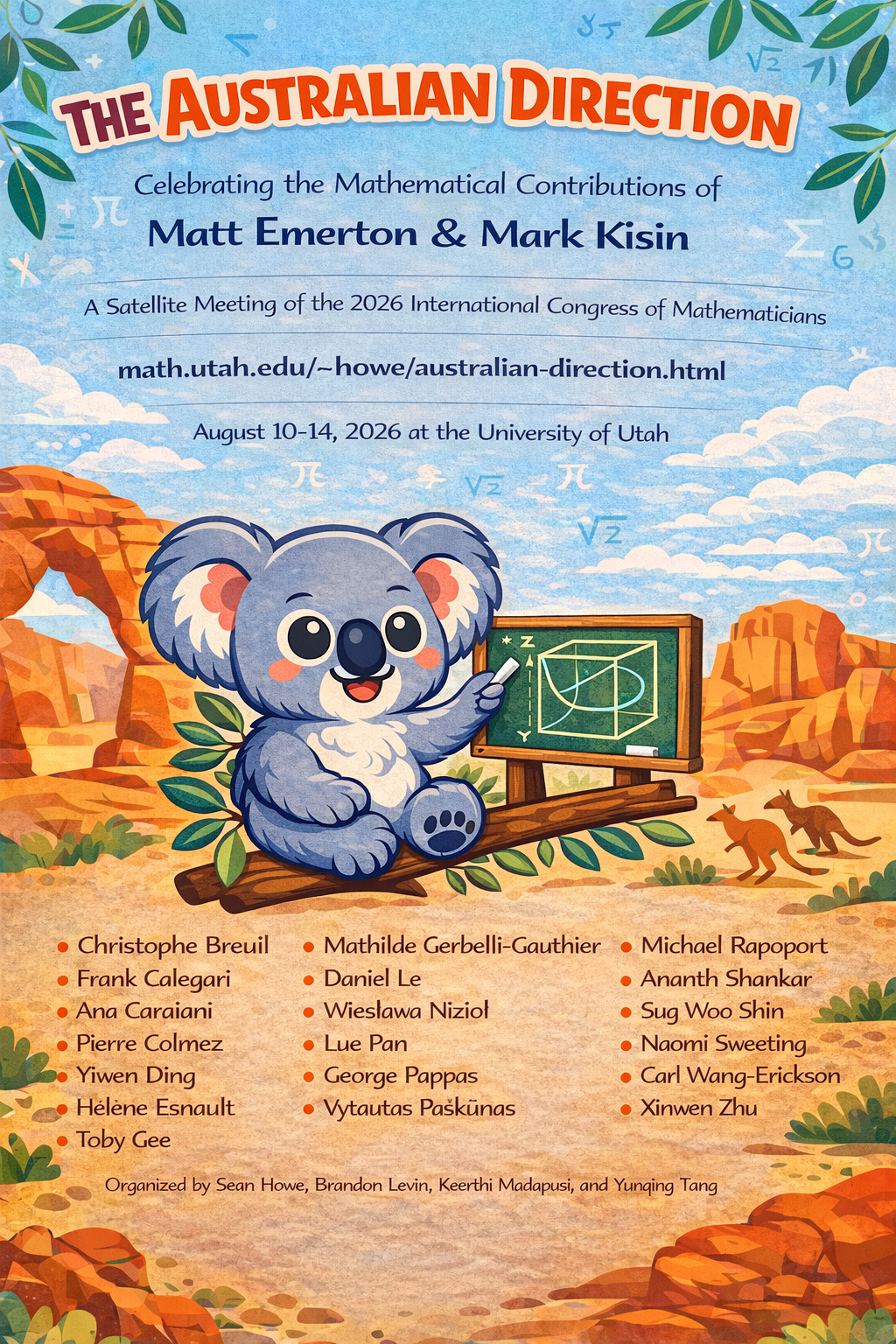
That, in effect, is the question I’ve been hearing at the conference I’m attending this week at the University of Utah, in honor of the 55th birthdays of number theorists Matt Emerton (University of Chicago) and Mark Kisin (Harvard). Graduate students and senior colleagues have come up to me to tell me they are regular readers of Silicon Reckoner; several have said explicitly that they agree with everything written here.
My purpose is not to boast. People are coming to me because for more than five years I have consistently been writing about mechanization of mathematics in a way that is not aligned with industry propaganda and the majority of media coverage but that apparently is consistent with how the majority of mathematicians, at least in my area, perceive developments in this area, and I have been the only mathematician doing so. I can’t claim that the positions expressed here are particularly original; regular readers will have seen numerous quotations from writers, business journalists, artists, and computer scientists, among others, who make arguments similar to mine, and who are almost all considerably better informed than I am. But it makes a difference to these colleagues and students that they are seeing these arguments being made by a mathematician. This is part of what it means to refer to mathematics as a community, and it’s something that the tech industry cannot replace.
The news is that I’m not, in fact, the only mathematician writing about mechanization and AI from a critical standpoint. I am aware of at least four new or recent developments:
To start with the most immediately accessible: Max Weinreich, a specialist in algebraic dynamics who is moving to CUNY Baruch College in the fall, has “present[ed] the case for total opposition to the use of artificial intelligence in mathematics” in an arXiv preprint entitled “The crisis of AI-generated mathematics,” and will be giving a lecture on his proposal on September 11. Registration for the Zoom event is here.1
Tasmin Chu, a graduate student in mathematics at Caltech, has just started a blog whose most recent entry, entitled, “The AI dissenter viewpoint” that asserts that “Mathematicians have moral obligations to resist AI companies” and calls for a “moratorium on asking LLMs to prove novel mathematical theorems.” Upon learning OpenAI’s announcement that its model had constructed a non-sofic group, Chu wrote a post concluding with the following prescriptions for mathematicians: Do not work for AI companies; Refuse all gifts and partnerships from AI companies; Use LLMs for mathematics judiciously, or desist from using them entirely. As of today (August 12) the blog has three lengthy posts on the implications and the social and political contexts of the development of AI for mathematics.
This July Kirwin Hampshire, a PhD student at the University of Victoria, published a blog post entitled The Dark Night of Mathematics. This one, like Chu’s post, was also a reaction to recent events: an expression of a “profound spritual crisis due to” the construction by LLMs of “a number of counterexamples to significant long-standing conjectures.” In the space of just a few weeks, Hampshire’s essay has been “liked” nearly 1300 times and has generated more than 400 comments.
And I have been contacted, undoubtedly not for the last time, by a colleague, whom I will not name for the moment, who is interested in developing a way to promote critical views within the profession.
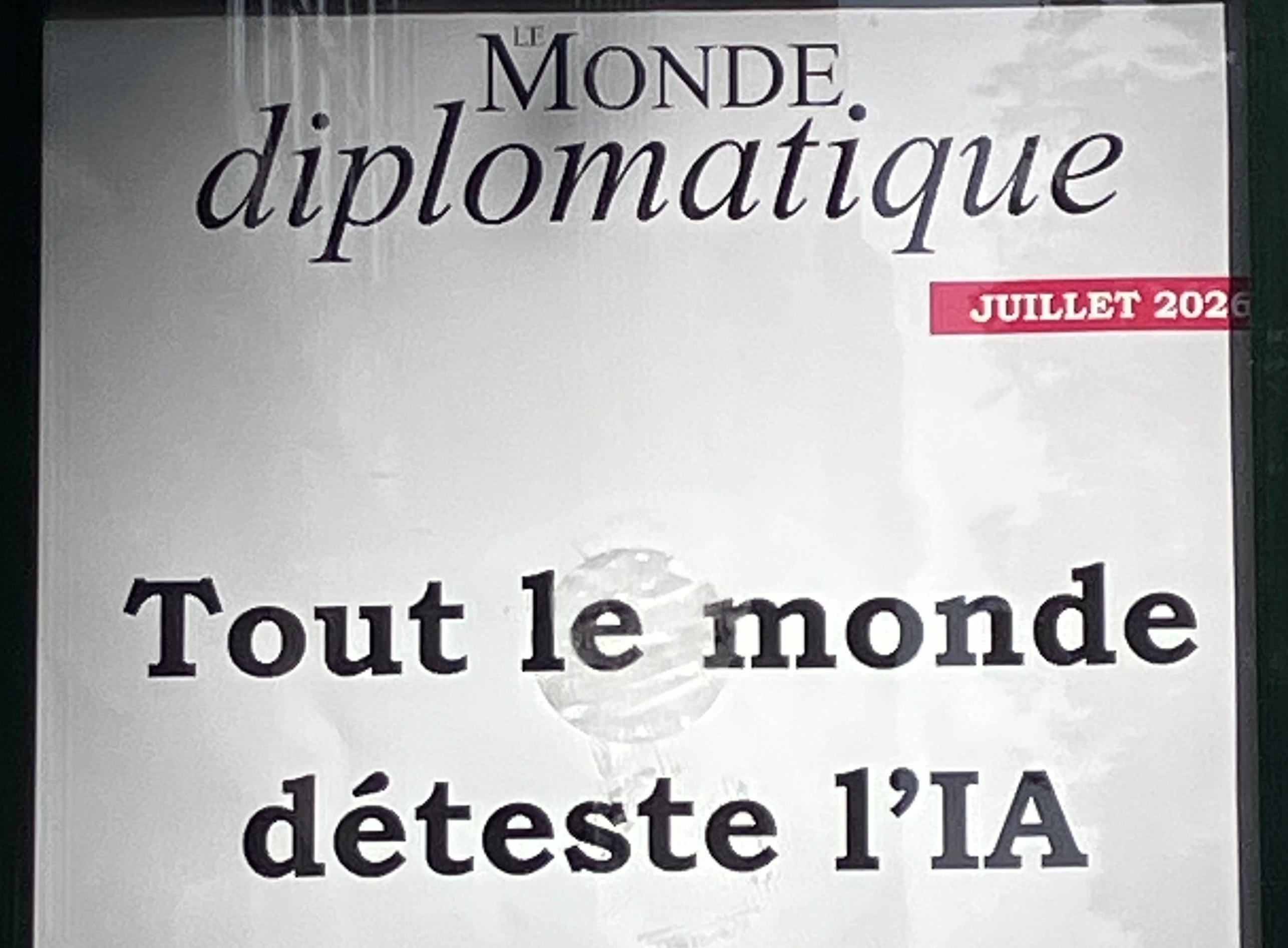
It is not the case, notwithstanding the Monde Diplomatique headline, that “everyone hates AI” at this week’s conference. Some agree with Weinreich’s call for “total opposition” and some are ready for a “moratorium,” as in Chu’s post, while others, including all four of the colleagues with whom I had lunch on August 11, have one or more subscriptions to commercial AI services and use them, so far with moderation, in their mathematical research. But it is probably fair to say that, at the conference, “[almost] everyone hates” the AI industry, whether or not they have warm feelings for the technology. That aligns this branch of mathematics, at least, with the public opinion reflected in the Monde Diplomatique article that accompanies the headline.
OpenAI open house for mathematicians
A frequent criticism of the Leiden Declaration is that it didn’t stress the potential benefits of AI for mathematics, as well as the threats. I find such a criticism frankly annoying, given that the news media have been bombarding us with claims about potential or even inevitable benefits for years, and the overwhelming majority of news coverage regarding AI and mathematics has been strictly aligned with industry messaging. Mathematicians quoted by the press may disagree with certain industry talking points, but most are on record sharing their belief that AI models will transform mathematics, and in a good way. This was also the message conveyed by nearly all AI-related activities at the ICM. It’s only recently — since the publication of the Leiden Declaration, to be more precise — that mathematicians who hold dissenting views have been given a public platform.
On the other hand, a rumor circulating at this week’s conference claims that a second Declaration is in the works, much more critical of AI than the Leiden Declaration. I had independently heard a similar rumor before leaving for the conference, and, rumors being what they are, I have no way to determine whether or not multiple Declarations may be made public in the coming months. It wouldn’t surprise me if the Monde Diplomatique diagnosis became the next big chapter in the continuing saga of AI disruption of mathematics.
One of the conference speakers confided to me that at least five of the young participants at this week’s conference believe that any colleague who opts to work with OpenAI or Anthropic or DeepMind or any of the other AI labs deserves to be shamed.2 I was not told their names and made no effort to identify them, but I assume the attitude is fairly widespread and growing.
Since I don’t know who among the 100 or so participants who are either students or early career researchers shares such attitudes, I can’t ask them how they feel about the “summit” held a few days ago at OpenAI, with the participation of a number of distinguished and more or less senior colleagues. I’ve been told that the meeting was “interesting” but the only concrete information I have about the event is that Daniel Litt gave a presentation, at the request of the organizers, and made his slides available on the internet, under the title “The End of Mathematics.” Litt writes,
The premise of the workshop (which we took as a starting point, rather than subject to debate, for the sake of productive discussion) was that AI will become robustly superhuman at mathematics. I want to tell a story in which, despite this, mathematical progress stalls. To be clear this is not a prediction--I'm optimistic by nature and think we'll find a way to adapt--but I am trying to imagine what a future in which certain existing trends continue might look like.
Fair enough. Litt’s slides do seem to have absorbed the dim view of human aspirations characteristic of Silicon Valley culture, as well as much of the local dialect — possibly the strongest argument in favor of shaming mathematicians tempted to defect, for the sake of their own ethical survival. But I don’t find his reasoning helpful in determining whether human mathematics will be going out with a bang or with a whimper; I suspect my reaction to any of the other presentations would be similar.
After reading Litt’s slides (or any other summit materials that may be made public), please ask yourself:
Does Litt’s “end of mathematics” scenario fill in the missing pages in the mathematical obsolescence script, by answering the questions at the end of this post?3
Does it answer the eight “questions to ask AI boosters” listed here?
Does it acknowledge the three kinds of “strongly negative” effects identified by Peter Scholze and quoted here: on “humanity, democracy and the planet”?
If you answer “no” to all three of the above questions, then you can safely ignore the scenario.
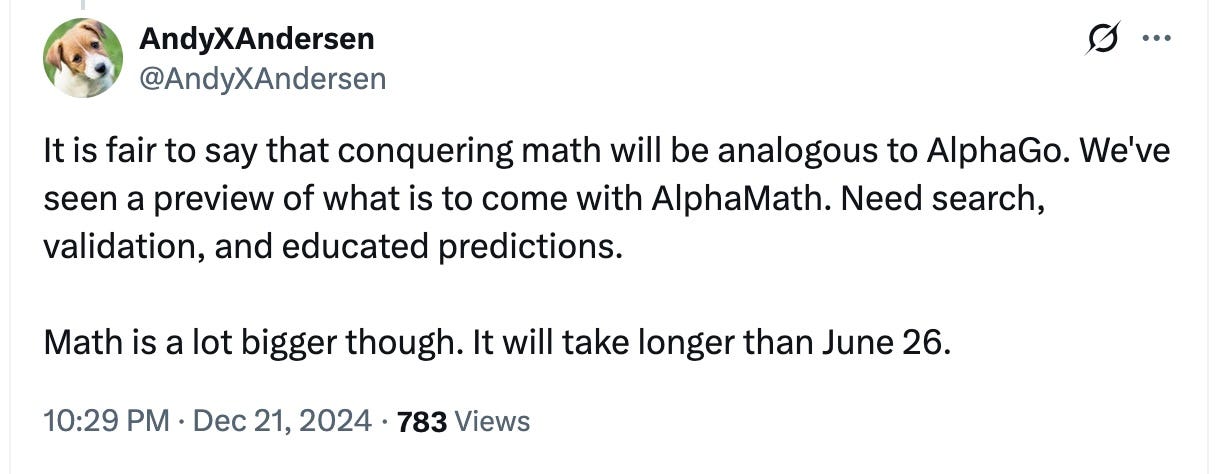
Meanwhile, the new conquistadors take aim at math
And a few other quotations collected at random:
If you’re hearing somebody say AGI is imminent, and they’ve been saying it for years, and they seem to have a financial incentive for saying it . . . I think you should question why they’ve been wrong so far.
(Nick Frosst, quoted in Financial Times, June 19, 2025)
when I learned how the Saline data center saga played out, what happened was the Saline Township board, unlike a lot of boards, actually voted 4 to 1 against rezoning their land for the data center. So this was a case where local government said: This is not our vision for our community. It’s not worth it to us.
And what happened? The data center developers sued Saline Township, a town of, again, a few thousand people, saying: Wait, no, this is exclusionary zoning. You can’t have no industrial use in your entire township. And when a town of that size is getting sued by a giant A.I. data center developer, they just settled.
They were just like: Fine, give us a few million for the fire department and for some schools, and this fight is not worth it to us. But that, to people, felt like a profound violation of little-D democracy. …
And so I think that the data centers, in that sense, are a very visceral microcosm of the way that a lot of people feel that A.I. is showing up in their lives.
(Jasmine Sun with Ezra Klein, “The A.I. Giants weren’t prepared for this,” NY Times, August 4, 2026)
While Hassabis is widely admired for his scientific leadership, several people familiar with Google’s thinking said senior executives had become frustrated by what they saw as his lesser focus on the commercial demands of the company’s AI business.
His decision to make AlphaFold, the protein structure prediction system which earned him a Nobel Prize in Chemistry in 2024, freely available became a source of tension inside Google, according to a person familiar with the matter. The project generated little commercial return despite the scale of its investment. …
Alphabet’s shares fell 5 per cent following the announcements, underscoring concerns about the mounting cost of Google’s AI push and the pressure on the company to demonstrate it can translate its research strength into commercially successful products.
(Financial Times, August 8, 2026)
… unlike the robber barons of the past, who were often charitably minded and gave generously to public institutions, the tech billionaires of the present show a “complete indifference” to any kind of “social contract” and any need to “compensate people for the disruption they have brought into their lives”, says Quinn Slobodian, a historian of capitalism at Boston University.4
(Financial Times, August 9, 2026)
Appendix: a philosopher on Claude as author
Thanks to Justin Clarke-Doane for pointing me to an article entitled “Philosophy Journal Publishes Largely AI-Authored Article — On Purpose (guest post)” Simon Goldstein is the philosopher responsible for this news item. He writes
This month I published my first philosophy paper written with AI.
This may or may not be an accurate account of the situation, because the framing article makes the rather different claim, more consistent with the article’s title, that
Philosophy & Public Affairs recently—and knowingly—published an article written mostly by Claude, Anthropic’s LLM.
It may seem frivolous to worry whether the philosopher or the journal published the article (which I hope I don’t intend to read), but it’s only logical in view of Goldstein’s conclusion from this experiment that “the field will need to answer … how to credit Claude in papers like this one.” The framing article offers Goldstein the opportunity to explain the “Why and How” of his experiment. He writes
For this paper, I chose to credit Claude as a method for writing the paper: I included a lengthy acknowledgment about the use of Claude. An alternative approach would be to credit Claude as an author of the paper. I am also tempted by this approach.
One question is who exactly would be the author in the vicinity of Claude. I think of the name Claude as analogous to the term Homo sapiens: it describes a kind of agent rather than an agent. But the individual AI agents or instances that users work with are not usually given names. One convention going forward might be to assign a name of something like the form: “Claude Opus 4.7 time-stamp user-name”. That is probably enough information to uniquely identify the agent that assisted with the project.
So I am open to both attribution as a method and attribution as an author. But this is a broader question for the field to decide as the use of AI in writing philosophy becomes more common. Here we will need to reflect on the function of authorship. Among other things, authorship serves as a signal that readers can use to identify similar content, and as a tool for assigning responsibility. The question is whether assigning authorship to Claude improves these functions.
Some mathematicians, readers will recall, are also “tempted by” the notion of AI authorship. Goldstein goes on to make dramatic predictions regarding
The Future of Writing Philosophy
I suspect that in the next few years, AIs will be able to write philosophy papers without the help of a human PhD supervisor. At that point, human philosophy professors will have to find new tasks to perform. Maybe the whole job will be focused on undergraduate teaching, until AIs automate teaching. In the meantime, I hope to spend my time as a philosophy professor doing a mix of writing papers on my own and writing papers as a “PhD supervisor” for AIs.
Soon, AI will cause significant increases in the number of good philosophy papers submitted to journals. For the journal system to continue, journals must soon develop new AI-based refereeing tools, like Refine in economics, in order for journals to keep up. That said, once the number of good papers gets too large, the journal system as we know it will probably collapse.
Readers are left to imagine what happens to philosophy after the journal system’s collapse.
Another Zoom event is scheduled in the same series, two weeks later, featuring mathematicians who are actively using and developing AI in mathematics. Half of the six listed panelists for this second event can be considered critical insofar as they have signed the Leiden Declaration.
Chapter 4 of my book Mathematics without Apologies, entitled “Megaloprepeia,” written more than 10 years ago, was intended in part to draw out the implications of training mathematicians to work for hedge funds. It could serve as a guide to shaming such people, but that’s not the sort of thing I could ever bring myself to do.
For the reader’s convenience I reproduce them here:
Where will that hypothetical superintelligent mathematics machine be built?
Who will operate it?
How will it be powered?
Who will build it?
And why?
I support activism - shame away! But maybe read the rest of this post first.
In my opinion, a couple productive ways for activists to channel their energy would be to:
(1) go on Twitter and criticize bad behavior, call out misleading or misinformed takes, douse hype (Thomas Bloom is great example to follow), etc.
(2) propose, in broad discussion with the mathematics community, realistic and concrete actions to improve the situation.
The sentiment that "everybody hates the AI industry" should certainly be given its fair share of airtime, but it is already quite well known.
Plenty of tech folks have made fools of themselves commenting on mathematics. Conversely, mathematicians may not understand the dynamics of tech labs as well as they think. For example, there seems to be a common misconception that AI companies want to "solve math" as a marketing gimmick to demonstrate superintelligence. This does not match my experience of the frontier labs (OpenAI, Anthropic, Google). It is true that Google employs many people with math backgrounds, who like to try math problems on their products for fun, and initially got overexcited with the results - I acknowledge my own guilt in this - but since then we have exercised considerable restraint behind the scenes.
Lastly, I'd like to advocate for one benefit of the technology. Wizened mathematicians like myself know that "proof indigestion" was a problem even before AI, and almost every paper of appreciable length contains serious mistakes (meaning beyond typos). One of my main research threads in AI is on natural language verification, this is the main way I use AI for my mathematics, and I'm happy that the models have reached the point of helping me catch many errors in my work. Once these idealistic young AI abstainers see how pervasive mistakes are in the literature, they may develop a slightly more accommodating view of the role of the technology. I am happy to provide trial refereeing for those who do not have ChatGPT subscriptions.
Weirdly enough (or maybe not), I recently observed that it bothers me a lot more when people don't write in their own voice than when they use an argument suggested by an llm. The later is ''oh, Frank learned some new tricks, this is how he thinks about that argument'' (no shade on any Franks out there), while the former is much more ''Frank is gone, it's just an llm speaking through him''. At this point this is just an emotional response, but I'm surprised by how visceral it is.
P.S.: I initially used Mike for my hypothetical person, but then realized that you might go by that so changed it to Frank...