
Tony Blair did describe globalisation as a process as inexorable as the weather, and that is also how neoliberals described the economy – a thing that happened to you.
(Zoe Williams, The Guardian, July 23, 2026)
Academic-industry dialogues
Three summers ago I spent countless hours watching and taking notes on a three-day workshop coordinated by the National Academies (of Sciences, Medicine, and Engineering) until the title AI to Assist Mathematical Reasoning, where most talks by mathematicians treated AI as “a thing that happened to” mathematics, like the weather. I devoted most of five posts to this workshop, all entitled (My) shallow thoughts about deep learning and subtitled “Grading the June workshop on ‘AI to Assist Mathematical Reasoning.’” My grades were harsh because the presentations were scored on five criteria: context1, access, externalities, democracy, and “cluefulness,” with regard to which I had written
when mathematicians have their hearts set on ignoring something nothing is too loud to break through their wall of silence.
Mathematicians who participated in the workshop scored poorly on all five, in striking contrast to the computer scientists who were thoroughly aware that the technology was not simply the spontaneous realization of an abstract wish-fulfillment.
If the 3000+ signatures on the Leiden Declaration are a signal that more mathematicians are attentive to such concerns, this month’s meeting, entitled Organizing Mathematical Knowledge in the Age of AI and Formalization, appears to be a throwback to simpler times. The many distinguished mathematicians who agreed to participate must have their hearts set on ignoring the presence on the program of Jesse Han of MathInc. If you read the June 8 New York Times article entitled “They Spent Years on a Math Problem. Then They Were Scooped by A.I.” then you know that it’s as if the Federal Reserve decided to invite Willie Sutton2 to discuss the future of banking, or the FBI invited Al Capone to discuss the future of policing. Both were experts in their respective sectors, and both were very good at what they did.
The topologist Patrick Massot and I have some strong disagreements, notably on whether or not I am well on my way to dementia, so I was heartened to see that he still clings to the core values of mathematics in his reaction to the MathInc fiasco, as reported in the New York Times article:
I also have some cordial but sharp philosophical disagreements with Jeremy Avigad, but I have found his efforts to frame the moral challenges mechanization poses to mathematics extremely enlightening (and quotable), so I was not surprised to read in the Times article that Avigad “let him have it,” referring to Han, at a DARPA meeting where the two were present: MathInc’s behavior, he said,
wasn’t good for them; it wasn’t good for math; it wasn’t good for anybody.3
The philosopher Fenner Tanswell took the MathInc incident as a paradigmatic example of what he calls “The Enshittification of Mathematics”4:
Consider for a moment the worst-case scenario of a future where mathematics has been fully enshittified. Human mathematicians can no longer contribute to collective projects because any open project is quickly completed by competing AI agents from rival companies.
Han was reportedly so nonplussed that the mathematicians at the DARPA meeting failed to applaud his act of piracy that he invented a new word (in red in the following quote) to characterize their ingratitude:
the “fear and Ludditivism” in response had “hardened my resolve” to use A.I. to “formalize all of mathematics.”5
We adults are supposed to have learned as far back as elementary school (“sticks and stones…”) that resorting to name-calling is a sign of stunted intellectual development, and an incapacity for sustained reasoned thought, and yet grown-up mathematicians go to great lengths to avoid being called Luddites, even by someone quite ignorant of the historical context they claim to be invoking. I would guess they would find the prospect of being doxxed as Ludditivites even more worrisome, although (or perhaps because) no one knows what this means. The flip side of this is illustrated by the self-identified Luddite community, organizers of last month’s Summer of Ludd festival
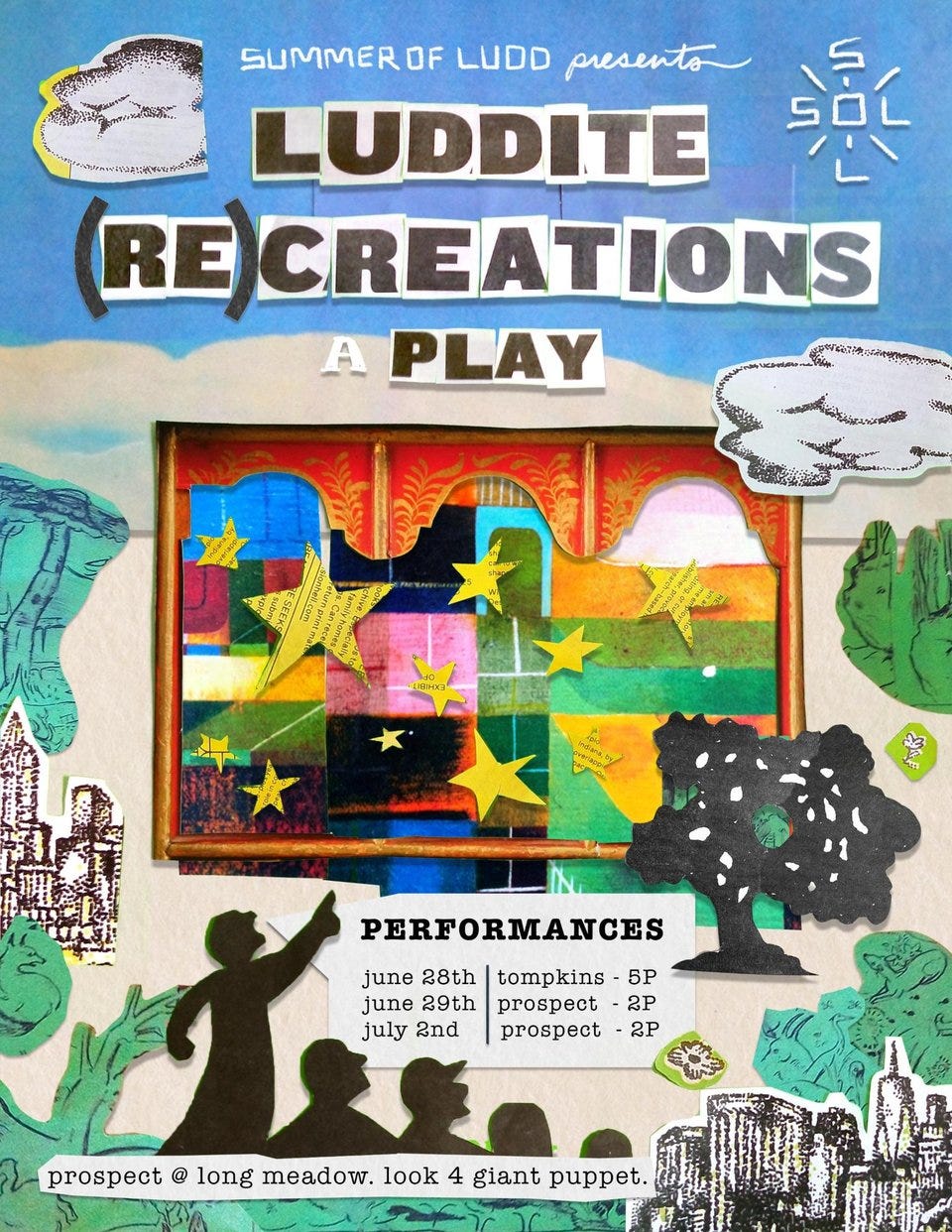
in New York. I suspect both the avoidance and the approach can be traced to the same psychological mechanisms, evolved hard-wired expressions of sensitivity to mammalian dominance hierarchies, as reviewed in psychological studies such as this one.6
I’d like to think my own aversion to people who indulge in childish name-calling is not a mechanical expression of spontaneous activity in a handful of inaccessible brain regions,7 but rather is a kind of existential distress triggered not only by the fact that there are such people but that something about our social organization rewards such people with extraordinary power. Readers are probably thinking of one such person every day, many times, but for present purposes it’s particularly distressing to note that the relevant personality traits seem to provide an evolutionary advantage in the tech industry.
An eyewitness who was present at the DARPA confrontation indicated that Avigad’s response to the MathInc outrage was much sharper than what the Times reported, but also that Han’s reaction was considerably more arrogant and dismissive than what I quoted above. Let me just conclude this segment by pointing out what these close encounters between mathematics and Silicon Valley portend. Not only will there be a clash of incentive structures, in which the industry holds a structural advantage; not only will the industry import alien practices, like trade secrecy and non-disclosure agreements, in which the industry holds a legal advantage. The clash of styles may be the most brutal of all. Personal modesty comes naturally even to the most successful mathematicians, as you can read in the various published interviews with this year’s Fields Medalists. Departures from modesty, as illustrated by Han’s announced intention to “formalize all of mathematics,” are considered highly distasteful. Is this going to change? Will Deans be encouraging our departments to hire more blowhards and megalomaniacs?
How one might acquiesce to the inevitable, with thoughts of cheese
The upshot is that I have been physically unable to watch the latest installment of the NASEM series, and not only because I have been preparing for a panel discussion of the Leiden Declaration at the ongoing International Congress of Mathematicians.8 On the scale of the tech industry’s ongoing corruption of public norms as well as public discourse, the MathInc outrage hardly registers; yet there is every indication that even holdouts in academia are being frog-marched into subscription to industry services. Kevin Buzzard recently posted this on his blog:
A few days earlier I had got an email from a professor in the maths department here at Imperial, expressing surprise that some of our graduate students were paying $200 per month to access models such as Sol and Fable. He said that he thought that these people were crazy. I did not immediately respond. But after meeting with Andrew I emailed the professor back and told him that in my opinion, any PhD student who was not paying $200 per month to access these tools was crazy. In fact during the workshop I learnt from Harvard PhD student Bryan Wang that Harvard were already giving free Fable access to all PhD students, post-docs and faculty at Harvard.
I’m thinking of ways to make peace with the idea that my profession’s future depends on establishing systematic relations with individuals whom a conventional moral calculus would deposit in Leavenworth. Meanwhile, regions of my brain not mentioned in Footnote 7 have been devising questions that I find genuinely interesting and that I believe current generative models would be able to answer, if I could overcome my moral repugnance.
The history of New York pizza9 may offer a way out. Al Capone’s lasting legacy is reasonably well known: Capone
took control of several Wisconsin farms and cheese producers and would use his intimidation tactics to force the hands of pizzerias 800 miles away in Manhattan and Brooklyn to purchase his cheese. Because the East Coast had a high density of Neapolitan immigrants, fresh mozzarella was often employed for pizza, but Capone pitched his Wisconsin-made cheese as a better-melting alternative. So, he made an offer they couldn’t refuse, and low-moisture mozzarella became the norm in NYC slice shops.
Mafia control of pizza along the Atlantic coast continued under mob boss Joseph Bonanno, Sr. in the 1980s, which just happens to have been the peak period for my personal consumption of pizza. Did I feel pangs of conscience, knowing that I was making regular contributions to a flourishing organized crime economy? Not at all; at the time I was convinced that was just how things were: “it is what it is.”10
Mathematics, at the time, could be seen as a refuge from the reigning cynicism. But maybe it won’t always be; and maybe that will be all right.
Defined as
Attention to the deep motivations of governments and corporations. (Not least the tendency to exaggerate the importance of developments in order to attract investment.)
These days I would add attention to signals from the financial market regarding the sustainability of the industry’s business model.
Famous for supposedly saying (though he denied it), when asked why he robbed banks, “because that’s where the money is.” Keep that in mind as you read today’s post.
Gregory Barber, “They Spent Years on a Math Problem. Then They Were Scooped by A.I.,” New York Times, June 8, 2026.
The following quotation is taken from Tanswell’s lovely article of that title, to appear in The Mathematical Intelligencer but apparently not available online.
Barber, Op cit.
Found, it should be acknowledged, after providing ChatGPT with the following prompt:
Starting with the sentence "Human reactions to insults are plausibly related to evolved mechanisms for monitoring social status, which have parallels in other social mammals," can you provide at least one peer reviewed reference?
ChatGPT listed the following as implicated in monitoring social status: Amygdala, Anterior cingulate cortex, Anterior insula, Ventromedial prefrontal cortex, Dorsolateral prefrontal cortex, Orbitofrontal cortex, and Striatum.
In an example of inspired planning, the discussion in which I am scheduled to take part, on July 26 from 3:00 to 4:30 PM, organized by the IMU Committee on Publishing, overlaps with the Joy of Why podcast, devoted to AI and mathematics, and also to Geordie Williamson’s public lecture on “AI and Humanity’s Long Conversation.”
And what makes it so great!!
And those enjoying Philadelphia’s hospitality this week may not be aware that the city’s most celebrated contribution to international food culture has long been associated with racism and xenophobia.
Massot has insulted me when I tried to make a small contribution to mathlib several years ago, and then, when I brought this event up on Mathstodon.xyz, went to (small) trouble of making an account there to denounce me there too.
It makes as much sense to argue with Massot as arguing with someone's badly mannered dog.
just commenting to draw your attention to this: https://www.ft.com/content/bdb3b820-905b-431e-82c0-386535755af1